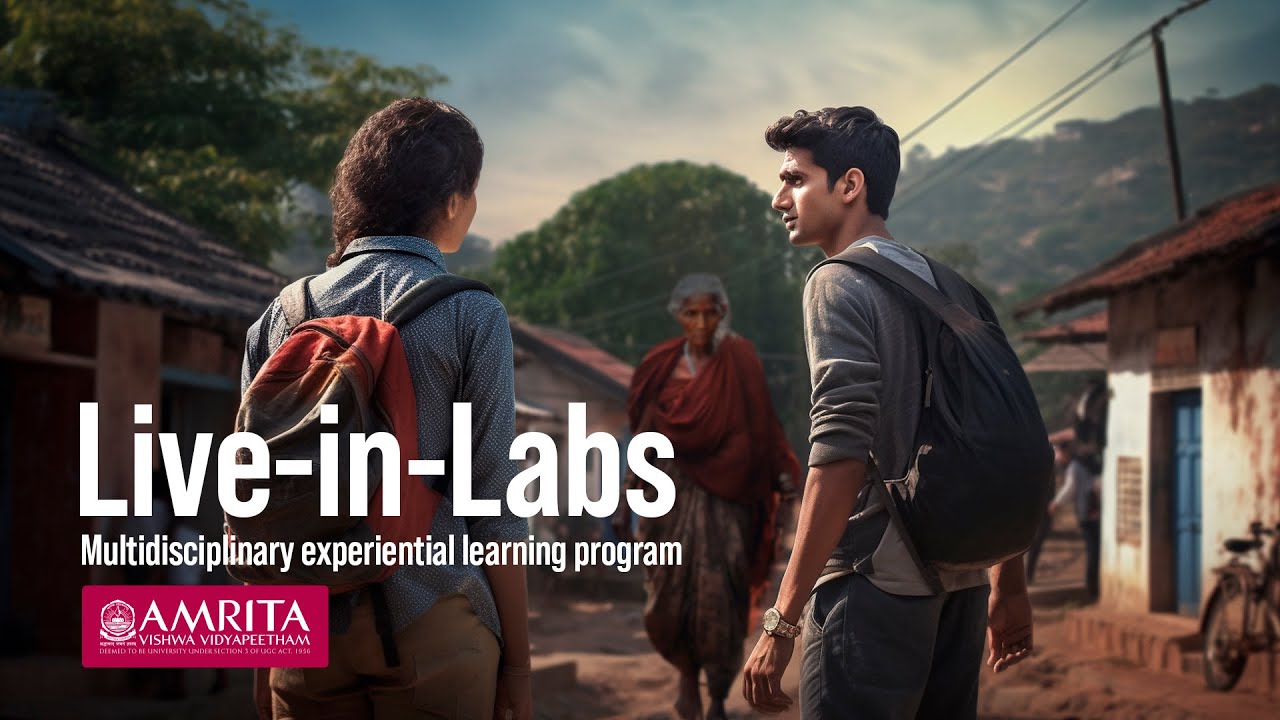
Amma envisioned that universities could send their students to impoverished villages or city slums as part of their education.This firsthand experience would not only help them grasp the issues the poor confront, but would also kindle compassion, inspiring them to find solutions.
In 2013, to bring Amma’s vision to life, Amrita University initiated ‘Live-in-Labs’. It is an internship program where students spend time in villages throughout India. They witness firsthand the challenges the poor face in their daily lives. They also consult with the villagers to develop sustainable solutions. Students with more than 30 universities from around the world also arrive to take part.
Amritavarsham is a day Amma’s devotees from around the world look forward to each year. For them, celebrating Amma’s birth is an opportunity to gather in large numbers to show her their love and gratitude.
Amma says that she doesn’t like to have a birthday celebration. But she agrees because it makes her children happy to join together in selfless service and prayers for world peace.
Join us on the 2nd & 3rd of October 2023 as we celebrate the monumental milestone of Amma’s 70th birthday!
Amma envisioned that universities could send their students to impoverished villages or city slums as part of their education.This firsthand experience would not only help them grasp the issues the poor confront, but would also kindle compassion, inspiring them to find solutions.
In 2013, to bring Amma’s vision to life, Amrita University initiated ‘Live-in-Labs’. It is an internship program where students spend time in villages throughout India. They witness firsthand the challenges the poor face in their daily lives. They also consult with the villagers to develop sustainable solutions. Students with more than 30 universities from around the world also arrive to take part.
Amritavarsham is a day Amma’s devotees from around the world look forward to each year. For them, celebrating Amma’s birth is an opportunity to gather in large numbers to show her their love and gratitude.
Amma says that she doesn’t like to have a birthday celebration. But she agrees because it makes her children happy to join together in selfless service and prayers for world peace.
Join us on the 2nd & 3rd of October 2023 as we celebrate the monumental milestone of Amma’s 70th birthday!
Amma envisioned that universities could send their students to impoverished villages or city slums as part of their education.This firsthand experience would not only help them grasp the issues the poor confront, but would also kindle compassion, inspiring them to find solutions.
In 2013, to bring Amma’s vision to life, Amrita University initiated ‘Live-in-Labs’. It is an internship program where students spend time in villages throughout India. They witness firsthand the challenges the poor face in their daily lives. They also consult with the villagers to develop sustainable solutions. Students with more than 30 universities from around the world also arrive to take part.
Amritavarsham is a day Amma’s devotees from around the world look forward to each year. For them, celebrating Amma’s birth is an opportunity to gather in large numbers to show her their love and gratitude.
Amma says that she doesn’t like to have a birthday celebration. But she agrees because it makes her children happy to join together in selfless service and prayers for world peace.
Join us on the 2nd & 3rd of October 2023 as we celebrate the monumental milestone of Amma’s 70th birthday!
The Sri Chakra Raja chariot of Lalithaṃbhika was attacked from the rear by the army of the Asurās. Mantriṇī and Dhandini Devī came up to Sri Lalithaṃbhika, beseeched her forgiveness for their momentary lapse and requested her for an effective resistance from such ambushes and attacks. Sri Lalithaṃbhika turned to Jwalamalini, one of the fifteen Nitya devīs. She said it is our duty to protect the śakti Sena”. She commanded her to make a fortress of fire around the śakti Sena. Jwalamalini Devī is one of the presiding deities of fire.
She created an impenetrable fortress of fire, spanning kilometers in length and breadth. The fortress blazed like diamonds. The śakti Sena stayed within its protective radius. Bhandāsurā heard this news. His thirty sons had been killed, the war was going against him. He still did not want to declare open war. He decided to try another tricky tactic. He ordered Viṣukrāna to start out at night with a small army. They moved undetected under the cover of night, they carried out black occult magic. It is said that they created many “Vighña Yantras”, Performing homa for the dark powers, sacrificing animals to propitiate them. They chanted mantras of black magic and their purpose was to make the śakti sena dim witted, listless and dispirited. This was their tactic to defeat śakti Sena. They approached the fortress of fire. They needed to place the “Vighña yantra” inside the fortress. Black magic practiced today to torment people was also being practiced long ago. They brought hordes of black magicians and sacrificed a countless number of animals. They chanted mantras of destruction, believing that it would have the desired effect. The effect of this mantra were several. It will make a person extremely lazy, inclined to show kindness to those who don’t deserve it. It will erode their confidence, leaving them feeling useless and unworthy. It will make them drowsy and constantly sleepy. They’ll lose interest in everything and feel utterly drained of strength, with no loyalty to their superiors.
Viṣukrān approached the fortress of fire with a vast array of machines designed to obstruct and hinder. He attempted to hurl them inside the fortress, but the fierce flames rose kilometers into the sky, blocking his path. So, he placed these hostile machines outside the fortress. Finally, with great stealth, he skillfully hurled them toward Devī’s army. They settled among the Shakti Sena, unnoticed. Devī is all-knowing, there is no need for Her to actually see with Her own eyes to be aware. In Sri Lalitha Sahasranama, Devī is hailed as,
sahasrākṣī
[She who has a thousand eyes]
(Sri Lalitha Sahasranama – 283)
sahasrapāt
[She who has a thousand feet]
(Sri Lalitha Sahasranama – 284)
She is praised as sahasrākṣī and sahasrapāt, the One who is omniscient and omnipresent. Yet, Devī pretended to be unaware and feigned ignorance of what was unfolding. The Vighña yantra were skillfully deployed, and even in the divine presence of Devī, the machines began to produce their intended effect. A sudden deterioration was evident among the śakti Sena, though no one understood the reason for this abrupt shift in behavior.
Devī, ever-aware, does not reveal the cause. She sits seemingly indifferent, detached from the events around Her. No one else understands the reason or even suspects there might be one. The Shakti Sena became dull-witted, drowsy, and reluctant to fight. They thought, “Why should we sacrifice ourselves for the glory of our master?” In their lethargy, they invented bizarre excuses to avoid battle. They laid down their weapons, declaring their intent not to fight for the benefit of others at the cost of their own lives. Over half the army fell into a deep sleep, while the rest reasoned, “The Asurās are also Devī’s children. Killing them would be wrong.” They questioned, “Why engage in this needless war?” and claimed, “Our true dharma is Ahiṃsā, non-violence.”
In this way, they grew lazy, drowsy, and began to show misplaced kindness. Confidence in their abilities waned, and their will to fight vanished. We are recounting the events leading up to the death of Bhandasura, as recorded in the Sri LalithaSahasranāma . More details will follow in upcoming episodes.
We continue the account of the battle that led to Bhandāsurā’s demise, as recorded in the śrī Lalitha sahasranāma. Viśangāna attempted to ambush Devī from the rear, but his plan failed. śrī Lalithaṃbika commanded the fifteen Nitya Devīs, her constant companions, to engage in battle. They swiftly attacked and obliterated the fifteen Akṣauhinisa led by Viśangāna. Realizing the disaster this tactic had brought upon his forces, Bhandāsurā began to deliberate and summoned his thirty sons for counsel.
Their unusual names are as follows, Chaturbahu, Cakorakṣana, Chatussiran, Vajraghoṣana, Simhaghośan, Ghandalāna, Chandavarnan, Pūramarāna, Svargaśatṛ, Athimayan, Upamayan, Anthakāna, and Yamanthakāna, among others. With great affection, Bhandāsurā gathered them around him. “Dearest sons, I sent our renowned soldiers into battle, believing we were facing an ordinary woman. Alas, all of them were slain by the śakti Sena. We had once defeated Indra, a victory won solely through your strength. You have brought me triumph in countless wars.
Therefore, Bhandāsurā commanded, “Please enter the battlefield and capture our opponent, this weak and helpless woman.” The rules of war dictated that army commanders should only engage with their equal counterparts, horsemen with horsemen, and elephant brigades against opposing elephant brigades. Warfare was meant to be conducted between equals in strength and authority. Devī’s army remained vigilant, having narrowly escaped defeat the night before. Mantriṇī and Dandhinī readied themselves to confront the advancing enemy, but were halted by Bala Tripura Sundarī.
Bala Devī is the beloved child of the śakti Sena, said to be just nine years old. She holds a necklace of Rudrākṣa beads and a book of mudrāsa in her four divine hands, symbolizing assurance of refuge and blessings. Remarkably, she does not wield any weapons. Embodying all knowledge, she represents true wisdom. Despite her seemingly vulnerable position, the others tried hard to dissuade her, questioning how a small, unarmed child could confront such powerful Asuras.
Bālā TripuraSundarī stood firm, declaring, “If the opponent is Bhandāsurā, then śrī Parameśvarī should confront him. However, I am the rightful one to counter the might of the Bhandāputras.” Reaffirming her decision, Bālā Devī approached Lalithaṃbika. Known as the life breath of Devī Lalithaṃbika, Bālā TripuraSundarī’s resolve saddened Lalithaṃbika who remarked, “You are only a child.”
“I brought you to the battlefield merely for appearances, not for actual combat,” said śrī Lalithaṃbika. “Why do you wish to fight? How can you confront such strong and cruel Asuras with your soft, tiny hands? Please, do not venture into battle.” śrī Lalithaṃbika tried her best to sway Bālā Tripura Sundarī’s resolve. However, Bala Devī stood firm, skillfully countering Lalithaṃbika’s arguments and ultimately winning the debate. Despite being unarmed, she remained resolute.
śrī Lalithaṃbika fashioned a small protective sheath of armor and a breastplate for Bālā Devī from a piece of her own armor. She created a chariot, named “Karṇi Ratha,” for Bālā Devī from her flower-tipped arrows, drawn by graceful swans. Armed and radiant, Bālā Tripura Sundarī headed to the battlefield. Everyone present, including the śakti Sena, bowed their heads in devotion and prostrated before her. Bālāṃbika blessed the śakti Sena with her tiny hands and smiled affectionately as she set out to confront her enemies.
Bālā Devī fought valiantly in a fierce war against all thirty sons of Bhandāsurā, who besieged her from all sides. Utilizing the Nārāyaṇa Astra, she instantly annihilated the massive army accompanying the Bhandās Putras. With a single arrow, she killed all thirty asuras effortlessly. After her victorious battle, she returned to Lalithaṃbika and prostrated before her. This moment, along with the form of Bālāṃbika, is uniquely described in the Lalitha Sahasranāma, not found elsewhere.
bhaṇḍaputra-vadhodyukta-bālāvikrama-nanditā
[She who delights in seeing the valor of the goddess bala who
is intent on killing the sons of bhanda]
(Sri Lalitha Sahasranama – 74)
Sri Lalithaṃbhika lovingly picks up child Bala Devī, cradling her in her lap and showering her with affection. It is said that she bestows her blessings upon Bālāṃbika. We are currently exploring the events leading to the demise of Bhandāsurā, as narrated in the Lalitha Sahasranāma. More details will unfold in the upcoming episodes.
Bhandāsurā received the grim news that seven of his key military chiefs had been killed in battle. He summoned his minister and convened another council of war. “We are facing repeated defeats,” he declared. “There is an undisclosed power that strengthens them. We were misled into believing they were merely ordinary women, which is why we did not send a more formidable army. The forces we did send, though strong and loyal, perished in battle. We must not underestimate this force. I have come to realize that their army is invincible in direct confrontation or conventional combat.”
“We can only defeat them through treacherous means,” Bhandāsurā said. He commanded Viśangāna, “Go to the battlefield, but do not reveal yourself. Find a way to reach Lalithaṃbika. This war will end with her defeat, so your task is to vanquish her. We must change our strategy and no longer engage in open battle, as the Asuras grow stronger at night. Use any means necessary to reach Lalithaṃbika and defeat her.”
Viśangāna set out under the cover of darkness, unknown to anyone, accompanied only by Kutilakṣana and a comparatively small army. According to the rules of war in those times, battles could not be fought at night. The śakti Sena would never anticipate a surprise attack from the rear under the cover of night. They would have removed their armor, sitting together, sharing news, and relaxing after the day’s fierce battle. All of them would be longing for a mischievous glance from Devī’s eyes, yearning for the compassionate look of Devī to caress them.
It is said that Devī rode on “Kusumākara,” her aircraft, and gave darshan to everyone. The śakti Sena devotedly hoped for Devī’s gaze to rest upon them for a while. However, Viśangāna launched his attack from the rear, hoping to escape detection and avoid coming within Devī’s sight. The śakti Sena, caught off guard by this unexpected assault, found themselves defenseless, resulting in many lives lost. Viśangāna’s army made some progress, advancing toward Devī’s chariot, the śrī Chakra Rāja Ratha, which was stationed at the back of the śakti Sena. The Asuras closed in on the chariot.
It was then that the śakti Sena snapped awake, realizing they had fallen victim to a great deception as the rules of war were broken. A skirmish erupted, and hearing the clamor of battle, Devī turned her gaze toward the commotion. She was seated in her chariot, conversing with the fifteen Nitya Devīs who always accompany her and stand equal to her. Devī is praised as…
nityā-ṣoḍaśikārūpā
[She who is in the form of the sixteen deities ]
(Sri Lalitha Sahasranama – 391)
śrī Lalithaṃbika Devī is regarded as the sixteenth Nitya Devī highlighting the glory of this divine assembly. The names of the fifteen Nitya Devīs are Kāmeśvarī, Bhagamālinī, Nityaklinnā, Peruṇḍa, Vaḥnivasini, Vajreśvarī śivadūthi, Tvaritha, Kulasundarī, Nitya, Nīlapathāka, Vijaya, Sarvamaṅgala Jwalamalini, and citra. Upon realizing that Viśangāna was rapidly approaching her chariot, slaying those in his path, she commanded the fifteen Nitya Devīs to engage in battle.
They defeated the fifteen Akṣauhiṇī senas that had marched with Viśangāna, forcing him and Kutilakṣana to flee. According to the rules of war, those who abandon the battlefield are not to be killed, so they were permitted to escape. Mantriṇī and Dandhinī approached Devī, pleading for her forgiveness, admitting, “We were lax in our duties and should have been more vigilant against their evil intentions.” The Lalithopakhyānāṃ recounts this treacherous act of Viśangāna, which violated all established rules of warfare. We continue the tale of the battle that ultimately led to the destruction of the evil Bhandāsurā, with more details to come in the upcoming episodes.
We are hearing about the fierce battle that led to the death of Bhandāsurā. The commander-in-chief of Bhandāsurā’s army sent five of his strongest and most ferocious asuras to fight against the śakti Sena. He urged them, “Fight for your country; if necessary, give your lives.” True to his words, all five sacrificed their lives in battle. Their names are listed in the Lalithopakhyānāṃ: Karangāna, Kakavacitna, Vajradantāna,Vajramukhāna and Vajraromana. They arrived in war with very peculiar escorts.
Vajradantāna arrived at the battlefield in a chariot drawn by a hundred donkeys. The weapons of Vajramukhāna and Vajraroman were as sharp as diamonds. In the ensuing ferocious battle, they employed the weapons of Maya and the occult powers they had mastered. They conjured a demonic śakti named Sarpiṇī who produced millions of snakes from her body. These snakes wreaked havoc in the śakti Sena, biting the warriors with their vicious fangs.
Many warriors fell unconscious from the powerful bites, and the śakti Sena appeared to be on the verge of defeat. At that crucial moment, śrī Lalithaṃbika appeared among them. She looked upon her distraught warriors with compassion and smiled gently at Mantriṇī. Mantriṇī. then manifested the divine Nakulī Devī , awakening the inner spiritual power lying dormant within her. From Nakulī Devī’s body, many mongooses were born.
The mongooses tore apart the snakes slithering across the battlefield. The Lalithopakhyānāṃ details the slaying of the five powerful asuras sent to defeat the śakti Sena. Upon learning of the deaths of his five fiercest asuras, Kutilakṣana dispatched seven more chieftains, commanding the strength of a hundred Akṣauhinisa. The war was turning into a gruesome bloodbath, and all seven asuras had received boons from the Devas.
The seven were named Valahakan, Sucimukhāna, Vikatanan, Karalakṣana, Karatakāna, Balamukhan, and Vikarnan. These army chiefs rode on vultures, crows, eagles, ghouls, hens, ghosts, and Vethala (a paranormal being). It is said that the wingspan of the birds they rode spanned kilometers in length and width. They joined the battle, tearing apart, trampling, and flinging aside anything in their path.
The Devīs’ warriors were attacked by the sharp, cruel beaks of the seven asuras. It is said that these asuras had received a boon from the Sun God: the heat of multiple suns would descend upon anyone who confronted or even glanced at them with hostility. Scorching flames would turn everything to ashes, and the heat generated by their mere presence would be unbearable. At a critical moment in the battle, the asuras began wielding this boon as a weapon. They flew around on their monstrous vehicles, spreading flames everywhere. The śakti Sena became exhausted, their bodies bleeding profusely, and defeat loomed. śrī Lalithaṃbika was informed of the impending disaster. With compassion, she looked at Aaśvarudhā Devī, from whom Thiraskariṇī Devī manifested.
The Sanskrit meaning of “Thiraskaraṃ” is to conceal or hide. The asuras created immense, roaring flames and unbearable heat. Thiraskariṇī Devī arrived on a vehicle named “Thamoliptham” (that which is hidden or covered by darkness) and entered the battlefield in her flying chariot. She subdued the roaring flames and stabilized the temperature of the śakti Sena’s bodies. Ultimately, she defeated all seven asuras.
Bhandāsurā was informed about the significant defeats suffered by his army. He lamented, “It seems that the race of asuras will soon be entirely destroyed.” The Lalithopakhyānāṃ continues to describe the chaos and fear that have overwhelmed Bhandāsurā. We are recounting the events leading to Bhandāsurā’s destruction, as detailed in the śrī Lalitha Sahasranāma More will be revealed in the coming days.